
Ocean Freight Rates
- Monday September 15, 2008
This analysis featured in the September 15, 2008 issue of the HGCA's MI Prospects, Volume 11, Issue 6
Key Points
Ocean freight rates have continued to rise since last year, setting a new record level in May 2008. The softening of global economic prospects is not expected to have a major impact on the dry bulk freight market. However, a growing dry bulk fleet may mean lower ocean freight rates for grains and oilseeds in the near to medium-term.
Ocean freight rates for grain and oilseeds, like other commodities, are determined by the interaction of the demand for cargoes by ocean vessel owners and the supply of dry bulk cargoes by traders. Grain and oilseeds represent about 15% of major bulk cargoes. The volume of grain trade is relatively stable between years, although it can be quite seasonal on certain routes. Trade volume of some of the industrial commodities including iron ore, steam coal, coking coal, cement, bauxite and forest products have in the past been more cyclical.
Panamax sized (60,000 to 70,000t) and smaller Handimax and Handy sized vessels tend to be used for grain, as sources and destinations for cargoes are more dispersed than for industrial commodities. Larger Cape sized vessels tend to be preferred for commodities like coal and iron ore for which cargo sources and destination are more concentrated.
Prior to 2003 the cost of ocean freight was not a significant cost for the grain trade. Shipping grain across the Atlantic would typically run to $10 to $15/t (Graph 1). Over the 12 months to April 2004 vessel utilisation rose and rates tripled, peaking at more than $40/t for the US Gulf-northern Europe voyage. It was then anticipated that rates at this level would result in a surge in vessel building which would eventually match trade needs and temper freight rates.
Over the next two years ocean freight rates did in fact decline, but rather erratically, and the size of the ocean fleet rose as more vessels were commissioned and vessel scraping was reduced (Graph 2). Since the spring of 2006, however, rates have advanced again, reaching $88/t this May for the trans-Atlantic voyage. Rates have also been unusually volatile.
The growth in the Chinese economy in general and its steel industry in particular have had a dominant influence on the dry bulk ocean freight market. Over the last five-years Chinese steel production has risen from about 200Mt per year and less than 20% of world production to more than 500Mt (to over 40% of world production). The inputs for steel production coking coal and iron ore represent almost half the ocean trade volume of major bulk commodities and the outputs of steel is more than a third of the minor bulk commodities. Trade appears to involve longer voyages, particularly that of sourcing iron ore from Brazil.
It is therefore not surprising that freight rates for Cape sized vessels used for iron ore and coal appear to have led the market higher and have also been particularly volatile. Average monthly daily charter rates in this sector rose from less than $30,000 per day in May 2006 to more than $175,000 per day this spring. Much of this has spilled over into the markets for smaller vessels with the inevitable impact on costs of shipping grain. Future fortunes of the Chinese steel industry will continue to be very central to prospects for ocean freight rates for grains.
A general consensus is that global economic conditions are weakening and that demand of bulk commodities in the developed economies of North America, Western Europe and Japan will soften (Table 1). This may not be true for developing economies, particularly for China. Here, a large proportion of demand for steel input and other industrial commodities relates to investment in infrastructure and projects planned before the turn in the fortune of developed economies.
With respect to China, the Australian Bureau of Resource Economics suggests some recovery in 2009 steel production following slower growth in 2008 caused by severe snow storms, earth quakes and the Beijing Olympics. Increases in iron ore prices negotiated by suppliers and lower prices for steel would suggest declining profits and may signal the likelihood of slowing of expansion in steel production. But China is still largely a command economy, so normal economic indicators may not be reliable. Even more physical indicators, particularly inventories of iron ore and steel may not be as indicative as they may seem at this time. Increased iron ore stocks may simply reflect the impact of temporary closures.
As to the supply of vessels, the near-term expectation is that the increase in rate of additions will accelerate as the result of recent conditions (Graph 3). There are also reports of plans for very significant rate increases in the building of dry bulk vessels for delivery in 2009, 2010 and 2011. Some scepticism over whether some of the new entrant to ship building will be able to deliver on schedules remains in place.
Adding to the effective supply of vessels is an improvement in port congestion. The situation at east coast Australian coal ports where congestion was worst has improved. While during the first half of 2007 there were typically 150 vessels waiting to load, there are currently 50 vessels. This adds about 100 vessels to the effective dry bulk fleet.
Ship owners have been faced with some very substantial cost increases. With current freight rates this does not seem to have been a deterrent to investment.
In aggregate a downward bias in the ocean freight rate outlook is evident and as similar to the 2004 to 2006 period, the decline is likely to be erratic.
Specific to the grains sector of the freight market is the recovery in wheat output and export availability particularly in Europe. Although the volume in seaborn trade is not expected to change much, voyage lengths are likely to shorten, reducing aggregate demand for ocean freight services by this sector.
continue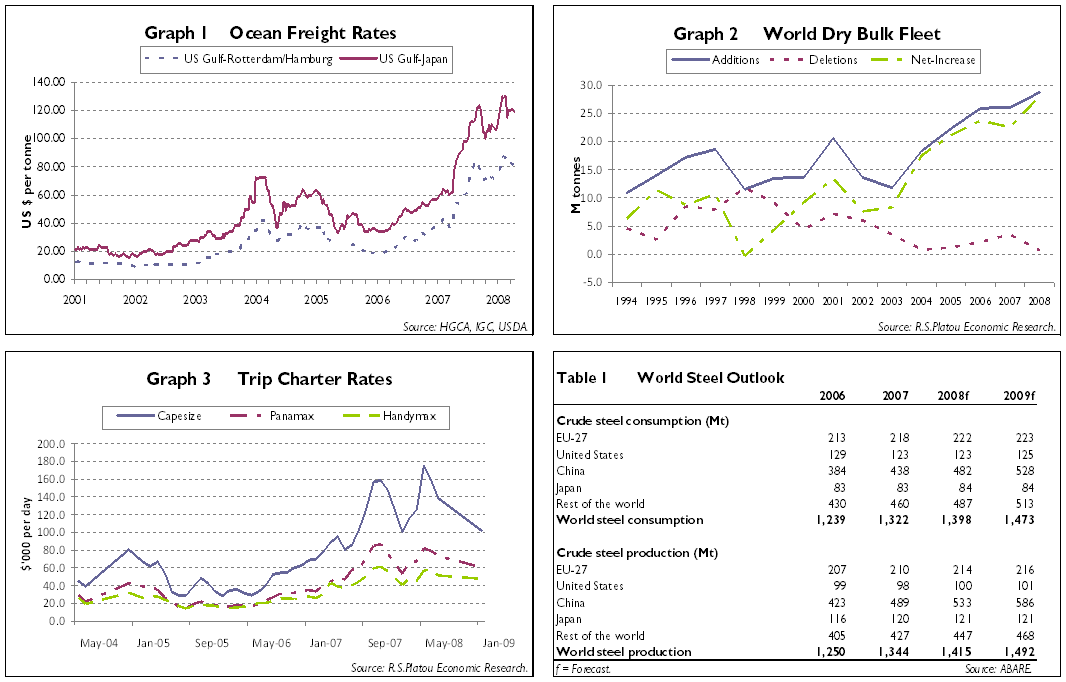
David Walker 001 780 434 7615
top of page